
Views: 0 Author: Site Editor Publish Time: 2026-08-28 Origin: Site


Edge preparation frequently acts as the hidden bottleneck in heavy welding operations. This critical phase directly dictates weld integrity, X-ray pass rates, and overall fabrication throughput. Fabrication managers face a continuous operational trade-off. They must choose between the accessibility of manual angle grinders and the precision, safety, and speed of mechanized beveling equipment. Relying on the wrong edge preparation method creates severe downstream consequences. It leads to excessive abrasive consumption, high rework rates, and detrimental metallurgical degradation.
This technical evaluation deconstructs the operational and metallurgical differences between manual grinding and mechanized machining. We examine the physical mechanics of material removal, dimensional accuracy, and operator safety. This framework helps you determine which method aligns with your production volume, material thickness, and strict quality requirements.
Metallurgical Integrity: A bevelling machine utilizes cold-cutting technology, preventing the formation of a Heat-Affected Zone (HAZ) and preserving the base metal's properties, unlike the high-friction heat generated by grinders.
Quality and Compliance: Mechanized beveling produces consistent lands and precise angles across both flat plates and curved pipes, drastically reducing costly X-ray reject rates compared to manual grinding, which relies heavily on operator muscle memory.
Scalability: For high-volume structural fabrication, integrating a steel beam beveling machine shifts edge prep from a manual, labor-intensive task to a predictable, scalable machining process.
Understanding the physical process of material removal is critical. The method you choose fundamentally alters the base material before welding even begins. Edge preparation requires removing metal to create a specific joint geometry, typically a V-groove, J-groove, or U-groove. The mechanics behind this removal dictate the quality of the final weld and the efficiency of the fabrication line.
Angle grinders rely on high-RPM abrasive friction to remove metal. The abrasive disc rotates at speeds often exceeding 10,000 RPM. As the grit contacts the steel, it physically tears microscopic fragments from the base material. This process relies entirely on operator skill. The operator must maintain a consistent angle using muscle memory and physical endurance. Fatigue sets in quickly during heavy material removal, especially when working on thick plates or heavy-wall pipes.
Manual grinding introduces inherent variability into edge preparation. The angle shifts slightly as the operator breathes, shifts weight, or adjusts their grip. The root face often becomes uneven. However, grinders offer unmatched flexibility for multi-tasking. An operator can bevel an edge, switch positions, and quickly chamfer a sharp corner without changing tools or setups. This makes the grinder a versatile, general-purpose tool for highly irregular shapes.
Abrasive wheels also wear down continuously during use. As the disc diameter shrinks, the surface speed decreases. This reduction in speed forces the operator to apply more pressure to maintain the same material removal rate. Increased pressure accelerates operator fatigue and generates even more localized heat. The manual grinding process generally follows a repetitive, inefficient cycle:
The operator marks the required land and bevel angle on the steel plate using a soapstone and combination square.
The operator begins grinding, attempting to hold the grinder at the exact required angle (e.g., 37.5 degrees).
After a few inches, the operator stops to check the angle with a bevel gauge.
The operator adjusts their grip and pressure to correct any deviations, often overcompensating and creating a wavy edge.
The abrasive disc wears down, requiring the operator to stop, lock out the tool, and replace the consumable.
The cycle repeats, with the operator's speed and accuracy degrading as physical fatigue sets in over the shift.
Mechanized edge preparation utilizes cold-cutting technology. Instead of abrasive friction, a bevelling machine uses milling inserts or shearing blades to physically cut the metal. This process shears away uniform chips. Cold-cutting transfers the kinetic energy into the metal chip rather than the base material. This leaves the prepared edge at room temperature immediately after processing, allowing fitters to handle the steel without waiting for it to cool.
These machines feature rigid mechanical guide systems. Rollers and guide plates lock the equipment onto the workpiece. This locks in specific angles, such as 30°, 37.5°, or 45°, without relying on operator steadiness. The root face remains perfectly uniform across the entire length of the plate or pipe. The machine dictates the geometry, eliminating human error from the equation. Once the depth and angle are set, the machine executes the cut with absolute repeatability.
Unlike grinders, these are purpose-built machines. They perform one specific task with absolute precision. Milling heads utilize replaceable carbide inserts that maintain their cutting geometry until they dull. The cutting diameter never shrinks. This ensures a consistent surface speed and a uniform material removal rate from the first inch to the last. The operator simply feeds the machine or monitors the automated carriage, drastically reducing physical exertion.
Mechanical Characteristic | Manual Angle Grinder | Mechanized Bevelling Machine |
|---|---|---|
Material Removal Action | Abrasive tearing and friction | Carbide milling or shearing |
Tool Wear Profile | Continuous diameter reduction | Fixed diameter, replaceable inserts |
Angle Control | Operator muscle memory | Rigid mechanical guide rollers |
Operator Exertion | High physical force required | Low, machine absorbs cutting force |
Surface Finish | Rough, heavily striated | Smooth, machined finish |
Weld quality begins with joint geometry. Inconsistent edge preparation guarantees inconsistent welding results. The transition from manual grinding to mechanized machining fundamentally changes the baseline quality of the fabricated part. When fitters work with perfectly machined edges, the entire welding process becomes more predictable and efficient.
The friction generated by an angle grinder produces extreme localized heat. This heat transfers directly into the base metal, altering its microstructure. This creates a pre-weld Heat-Affected Zone (HAZ). In carbon steels, rapid heating and cooling from grinding can cause localized hardening, forming a brittle martensitic grain structure. This hardened layer becomes highly susceptible to hydrogen-induced cracking, especially in high-strength low-alloy (HSLA) steels.
When working with stainless steel and high-nickel alloys, grinding heat causes even more severe issues. It can lead to chromium carbide precipitation, commonly known as sensitization. This destroys the material's corrosion resistance along the weld joint, leading to premature failure in field applications. Mechanized cold-cutting remains thermally neutral. The milling process shears the metal without elevating the temperature of the base plate. This preserves the original metallurgical properties and ensures the filler metal bonds to structurally sound, unaltered steel.
Manual grinding rarely produces a perfectly straight bevel. The angle undulates along the length of the joint. The root face varies in thickness. When fitters bring two manually ground plates together, the joint geometry is highly inconsistent. Wide gaps require excessive filler metal, slowing down travel speeds and increasing heat input. Tight gaps prevent proper root penetration. These inconsistencies drastically increase the risk of lack of fusion, slag inclusions, and porosity.
Mechanized equipment operates within strict dimensional tolerances. A machined bevel provides a repeatable joint geometry. When fitters assemble machined plates, the fit-up is virtually perfect. Welders can set their parameters and maintain a consistent travel speed. This predictable environment directly correlates to higher first-time X-ray (RT) and ultrasonic (UT) pass rates. Reducing weld defects eliminates the need for gouging, re-welding, and subsequent re-inspection, which are massive drains on fabrication productivity.
Pipe fabrication presents unique edge preparation challenges. Maintaining a consistent land on a curved surface is notoriously difficult with a manual grinder. The operator must continuously adjust their wrist angle as they move around the circumference. This almost always results in a variable root face, making open-root pipe welding exceptionally difficult. A welder cannot maintain a steady puddle if the root face changes thickness every few inches.
Mechanized solutions eliminate these geometric inconsistencies. Orbital pipe bevelers clamp directly to the outside or inside diameter of the pipe. They rotate around the circumference on a fixed track, machining a perfect angle and land. Similarly, track-mounted plate bevelers travel along the edge of long steel plates, maintaining exact tolerances regardless of the plate's length. The mechanical guide system completely removes the curvature challenge, ensuring the joint geometry meets strict AWS D1.1 or ASME Section IX code requirements.
Fabrication throughput depends on predictable processes. Manual tasks introduce bottlenecks. Mechanized processes introduce scalability. Transitioning away from manual grinding allows fabrication shops to accurately forecast production timelines and bid on larger, more complex projects with confidence.
Linear inches-per-minute (IPM) removal rates highlight the stark contrast between methods. A skilled operator with a grinder might achieve a moderate IPM initially. However, human endurance is finite. Grinding speed decreases steadily over a shift as operator fatigue sets in. The operator must stop frequently to rest, change worn abrasive discs, and check the angle with a gauge. Over an eight-hour shift, the actual arc-on time for a grinder is surprisingly low.
Machine feed rates remain constant. A mechanized unit processes the first foot of steel at the exact same speed as the hundredth foot. Automated feed systems pull the machine along the plate at an optimized rate. This continuous operation drastically outpaces manual labor over a full shift. The machine does not require rest breaks, and carbide inserts last significantly longer than abrasive wheels. This allows the operator to focus on material handling and staging the next piece, rather than performing exhausting manual labor.
Historically, mechanized beveling required bringing the material to a large stationary machine. Modern cordless and portable plate bevelers bridge the gap between grinder mobility and machine precision. These compact units allow operators to perform rapid, high-quality edge prep directly in the field or on the shop floor. They are particularly useful for large weldments that cannot be easily moved.
Portable units utilize the same cold-cutting milling technology as larger machines. They clamp onto the plate edge and are manually fed or self-propelled by the operator. This provides code-quality joint geometry on heavy steel plates without the logistical nightmare of moving massive components across the facility. Cordless options further enhance this mobility, eliminating trip hazards and power cord management in tight spaces, such as inside storage tanks or ship hulls.
High-volume structural fabrication requires heavy-duty solutions. Portable tools eventually reach their throughput limits. Scaling up requires transitioning to stationary, automated machinery. Processing heavy-wall pipes, massive steel plates, and thick I-beams demands continuous, uninterrupted machining. Relying on manual tools for this volume of work will cripple a production schedule.
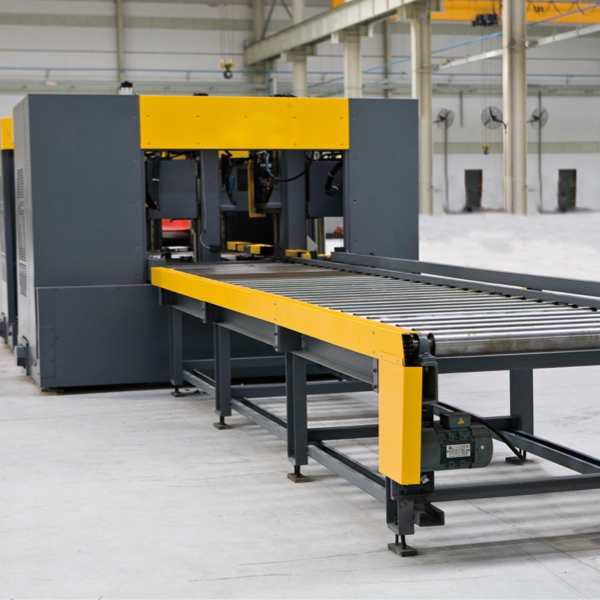
Integrating a steel beam beveling machine transforms a fabrication line. These stationary units utilize powerful spindle motors and massive milling heads. Material handling systems feed the steel directly into the machine. The equipment processes thick webs and flanges simultaneously. This level of automation shifts edge preparation from a labor-intensive bottleneck to a predictable, high-speed manufacturing step, allowing the shop to process tonnage at a fraction of the time.
Industrial fabrication environments carry inherent risks. Edge preparation methods significantly impact worker health and facility safety compliance. Mechanized machining inherently mitigates many of the severe hazards associated with manual grinding, creating a safer, cleaner, and more compliant workspace.
Prolonged angle grinder use exposes operators to severe ergonomic risks. The high-frequency vibration transfers directly into the operator's hands and arms. Over time, this exposure leads to Hand-Arm Vibration Syndrome (HAVS), also known as vibration white finger. This condition causes permanent nerve damage, loss of grip strength, and chronic pain. It is a major source of long-term disability in the metalworking industry.
Mechanized equipment drastically reduces operator vibration exposure. The machine's mass and rigid clamping systems absorb the majority of the cutting force. Self-propelled units require zero physical effort from the operator other than monitoring the process. Even manually fed portable bevelers isolate the vibration through the guide rollers and dampening handles. Protecting operators from HAVS reduces long-term worker compensation liabilities and improves overall workplace ergonomics, leading to higher employee retention.
Angle grinders generate massive amounts of hazardous airborne particulates. The abrasive wheel breaks down into fine dust, mixing with microscopic steel particles. Inhaling this dust poses severe respiratory risks. When grinding stainless steel, operators are exposed to hexavalent chromium, a known carcinogen heavily regulated by OSHA. Furthermore, grinding creates a continuous stream of high-velocity sparks. These sparks present a significant fire hazard, requiring extensive shielding, dedicated fire watches, and strict hot-work permits.
Cold-cutting machines eliminate both hazards. The milling process produces heavy, localized metal chips. These chips fall directly to the floor or into a collection tray. They do not become airborne, drastically reducing respiratory exposure. Because the process is thermally neutral, it generates zero sparks. This allows operators to perform edge preparation without heavy respiratory PPE and often eliminates the need for hot-work permits in restricted environments. This dramatically simplifies safety compliance and improves overall shop cleanliness.
Safety Hazard | Angle Grinder Risk Level | Mechanized Machine Risk Level |
|---|---|---|
Vibration Exposure (HAVS) | Extreme (direct transfer to hands) | Minimal (machine absorbs force) |
Airborne Dust / Silica | High (requires respiratory PPE) | None (produces heavy chips) |
Fire Hazard / Sparks | High (requires fire watch) | None (thermally neutral process) |
Noise Levels | High pitch, continuous | Moderate, intermittent cutting noise |
Operator Fatigue | Severe over an 8-hour shift | Low, operator monitors equipment |
Selecting the correct edge preparation method requires analyzing your specific production environment. Neither tool is universally perfect for every single application. Understanding the limitations and ideal use cases for each method ensures optimal fabrication efficiency and prevents unnecessary equipment purchases.
Angle grinders remain essential tools in specific scenarios. They excel in low-volume production environments where edge preparation is infrequent. They are invaluable for field repairs where bringing in heavy machinery is impossible. Grinders easily navigate tight clearances, inside corners, and highly irregular shapes that rigid machine guides cannot track.
Furthermore, manual grinding is often sufficient for non-critical welds that do not require strict X-ray inspection, such as simple tack welds or temporary lifting lugs. When working with very thin materials (generally under 1/4 inch), the setup time for a mechanized tool may negate any speed benefits. In these specific instances, the flexibility and immediate readiness of an angle grinder make it the practical choice for quick, localized material removal.
Specific operational triggers indicate the need to upgrade to mechanized solutions. High weld reject rates due to poor fit-up strongly suggest manual grinding is failing your quality standards. Scaling production volumes require predictable throughput that manual labor cannot sustain. Fabricating under strict welding codes, such as ASME Section IX or AWS D1.1, demands the geometric precision only a machine can provide.
Processing heavy-wall pipe or thick steel plate makes manual grinding highly inefficient. The sheer volume of material removal requires an industrial beam beveling machine or a heavy-duty portable unit. Upgrading becomes necessary when edge preparation becomes the primary bottleneck slowing down the welding department. If your welders are constantly waiting for fitters to finish grinding, it is time to mechanize the process.
Transitioning to fully automated edge preparation requires careful facility planning. Implementing a CNC H-beam beveling machine involves significant logistical considerations. Facility managers must allocate adequate floor space for the machine footprint and the associated in-feed and out-feed roller conveyors. You cannot simply drop a CNC machine into a crowded shop floor without planning the material flow.
Material handling logistics must support continuous operation. Overhead cranes or automated cross-transfers must keep the machine fed with raw steel to maximize arc-on time. Operators require specific training on CNC controls, tooling changes, and feed rate optimization. Establishing strict preventative maintenance protocols for the milling heads, drive systems, and coolant pumps ensures maximum uptime. Properly mitigating these implementation risks guarantees a smooth transition to high-volume automated processing.
Audit your current weld rework rates to identify failures caused by inconsistent manual edge preparation.
Measure the linear feet of heavy-wall pipe or plate processed weekly to determine if throughput justifies automated machinery.
Conduct a time-study comparing manual grinding against the published feed rates of mechanized equipment.
Consult with a tooling engineer to evaluate which cold-cutting method best suits your specific material grades.
Request a live demonstration of a portable or stationary unit on your actual production materials to verify surface finish and dimensional accuracy.
A: No. While mechanized equipment handles the vast majority of linear edge preparation, angle grinders remain essential for tight clearances, highly irregular shapes, quick chamfering, and localized weld repairs where machine setup is impractical.
A: Cold cutting physically shears the metal without generating friction. This prevents the formation of a Heat-Affected Zone (HAZ), avoiding localized hardening or sensitization. It also creates perfectly uniform joint geometry, ensuring consistent fit-up and reducing the risk of lack of fusion.
A: Portable units require minimal training focused on proper clamping and feed rates. However, stationary CNC equipment requires specialized training on software interfaces, material handling logistics, and specific preventative maintenance routines for the milling heads.
A: Yes. Modern portable and cordless units are designed specifically for field mobility. They clamp securely to pipes and plates, providing machine-shop precision in remote locations without requiring tethered power sources or heavy lifting equipment.
A: Advanced CNC equipment utilizes sensors and floating milling heads. These systems detect slight variations in material thickness or plate undulation and adjust the cutter position in real-time, ensuring the root face and bevel angle remain perfectly consistent.
A: For materials under 1/4 inch, an angle grinder is often more efficient. The time required to set up and clamp a mechanized tool on very thin sheet metal usually negates the speed benefits of the machining process.


